SGP Linebacker 2
It’s a restless day. I’ve had a nasty cold the last few days of the current week, which has thrown me off my game for everything. A pity as the Monday was stellar, particularly for being a first day back from a week of travel. Between plane and airport, I picked up some sort of bug. But now it’s Saturday, I’m feeling a bit better (but still not great), and itching to make some progress on anything at all.
Returning to my rebuild of Linebacker 2 seems workable.
I don’t recall exactly how I found this game, most likely
via a BGG search for Vietnam-era games. With some effort
I managed to locate some decent scans of all the parts of
the game, and have been intermittently converting the scans
to text for processing with LaTeX or rendering with SVG.
I’m a big fan of text and vector formats, very easy to
archive, and non-proprietary formats means I don’t get
locked out of my own work when tools move from purchase
to ransomware subscription.
The Swedish Game Production Linebacker 2 from Combat magazine Issue 8 is on my 2026 12 plays list. In order to play it, it would be helpful to have an actually playable game to get on the table. Much of the hard initial work has been done, with map, counters, etc. designed, printed, trimmed. Putting it on the table, however, is an instant assessment of form factor. In this case, the form factor is not quite there yet.
Here’s what I have so far:
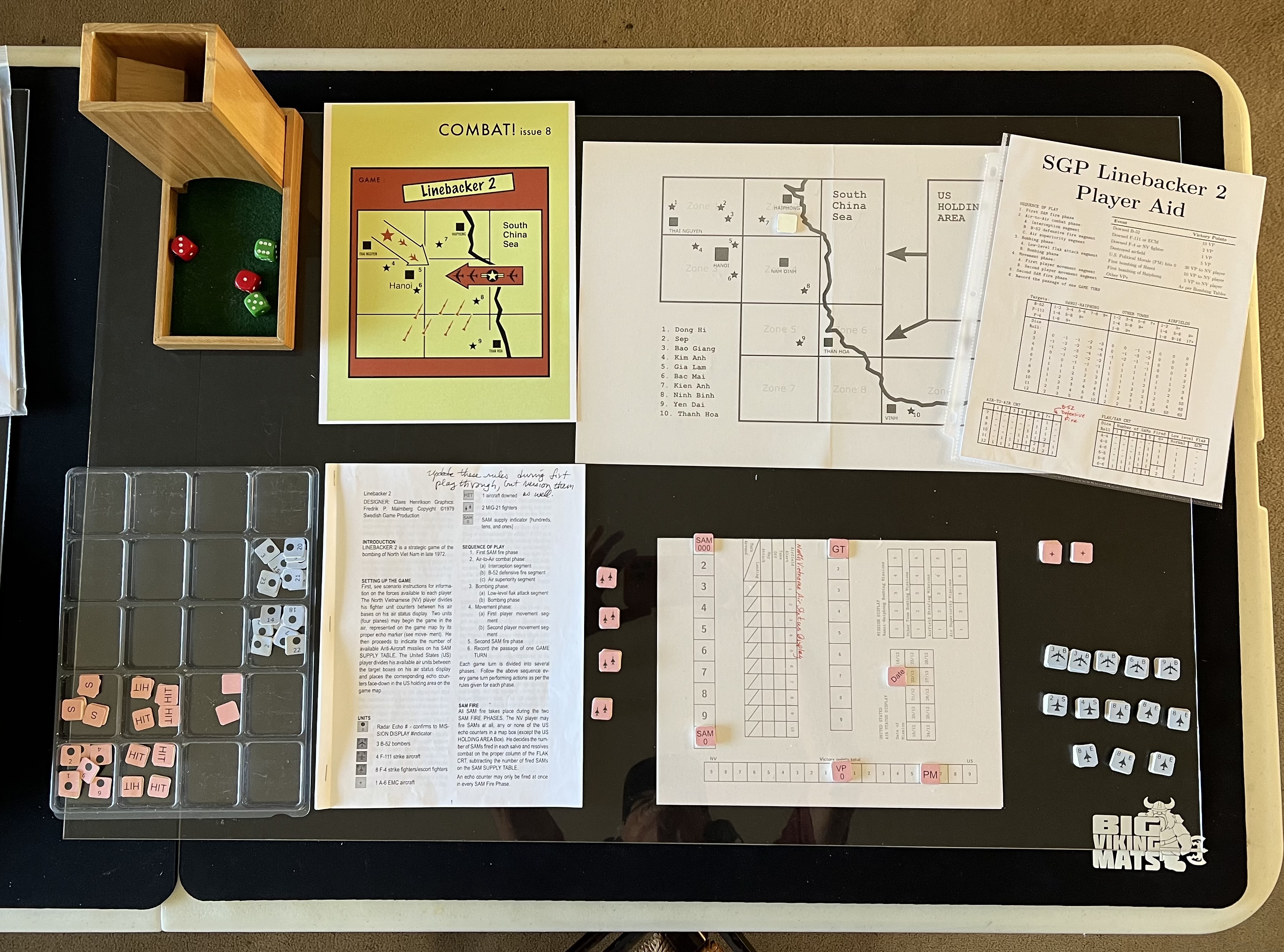
Unsolicited plug for Big Viking Mats: they are awesome and I need to invest in many more of the them. My usual opponent is green with envy, worth it for that alone. The plexi is 24x36 inches.
Learning the rules
The rules to Linebacker 2 are just a few pamphlet-sized pages. It is not a complicated game. There aren’t that many moving parts, not that many mechanisms to learn and the Turn Sequence is short and straightforward. This is not to imply the rules are unambiguous, correct in every aspect, or even complete.
It may be that game play will drive out some of the ambiguity. It will assuredly uncover more.
Map details
The map as originally published did not have a north arrow. From the relative position of the cities on the map, up is a little bit north of east. I like having north arrows on maps, so adding one to this map seemed like an obvious addition.
Adding a North arrow
One way to do it is by Mark I Eyeball, just draw something plausible and call it good. The way I do this is by orienting the features such that north is up, then draw an arrow. Another way to do it is to acquire the latitude and longitude of a few relevant features, perhaps on this map Hanoi, Haiphong, and Nam Dinh, then compute a best fit north arrow. This is appealing, but would be time consuming to look up the data, write a best fit routine, etc.
With Herman running on Fable 5, I just asked:
I took the six cities the map actually draws — Hanoi, Haiphong, Thái Nguyên, Nam Định, Thanh Hóa, and Vinh — and paired each drawn position with its real latitude and longitude projected onto a local flat plane. A similarity Procrustes fit (rotation and scale only, no reflection) then finds the single rotation that best lays the real constellation over the drawn one, and true north is simply where that rotation sends the real north vector: 52.7° counterclockwise of map-up. The fit’s residuals back it up — Hanoi lands within 0.04 map units of its drawn position, and the worst city is off by less than one.
The natural map unit is centimeters, and the worst city in this case was Thanh Hoa, off by 0.84cm (about 4% of the map’s width).
At this point, kudos to the designers, they nailed the relative locations of these 6 cities, which gives me a warm fuzzy feeling about the remaining features in the play area.
Setting up to play
Echo Counters are how the game simulates Fog of Battle. The NV player Echo Counters (EC), when placed on the map, indicate which Aircraft are in the air and ready for movement or combat. This is straightforward. There are 10 airfields and 10 ECs for North Vietnam.
The US places ECs into the US Holding Area on the map, with each EC corresponding to aircraft arranged the US Air Status Display. However, there are 23 ECs for the US, and only 20 positions in the US Air Status Display. Further confusing the situation is the positions are divided into four sets of 5, with each set numbered 1-5. There are 16 targets on the map: 10 airfields, 4 towns, 2 cities.
Many questions suggest themselves:
- Was the US scheme deliberate, and if so, why, and how do ECs numbering 1-23 correspond to Status indicators labeled 1-5?
- If it wasn’t deliberate, is it a game development oversight?
- Can targets be hit more than once in a turn?
- Is each EC resolved in each turn?
I am not a game developer. Apparently I am developing this game.
This is making my head hurt. I’m going to take a break and go for a walk, probably up to the Tilden Park Steam Trains. A good walk before a sedentary conference extravaganza will make it go better. I like to take pictures on my walks. Here’s a seasonally appropriate view of the Golden Gate bridge from La Loma park.

Too early for the steam trains, but coyotes were out.
And we’re back after a three week hiatus. It was a long walk! Actually, it was a long walk, but there was family, work, and travel drama occupying 20 of those 21 doys. Another long-ish walk provided an excuse for some Newportian productive meditation surfacing another list of questions for the US. Specifically, where are US plane counters actually placed at the beginning of a turn, including the first turn set up. Options include:
- On the status display;
- In holding box;
- On map.
Or does setup for the first turn differ from turns two onwards? I just realized I haven’t looked at the rules in three weeks.
I feel like I’m straying into game design territory here. I am not a game designer.
Given the setup, what are legitimate first moves? Here’s a list of possibilities:
- From Holding Box to map;
- From Status Display to map;
- From Status Display to Holding Box.
Then, I don’t see any hope for it, I’m going to have to set it up any which way and see how it plays out.
Idea: dummy counters and named boxes for towns, cities, and airfields.
Some examples of play
My usual opponent and I have a fool proof way of learning to play wargames: when in doubt, wing it. Winging it seems appropriate here, we’ll throw some planes on the map and see what happens.
Let’s bomb Haiphong!
We’ll fly a mission, to Haiphong, with B-52s, and drop some bombs. Here’s the details:
- Aircraft: B-52 (9).
- NV: SAM only.
Assume the Echo counter was moved into the Haiphong zone the previous turn.
- First SAM fire phase: NV fires 6 SAMs and roll 3-3, which is a whiff.
- Air-to-Air combat phase: N/A.
- Bombing phase:
- A. Low-level flak attack segment: N/A.
- B. Bombing phase: B-52 (9), roll 9 for 3 VP. Since this is the first Haiphong bombing, it incurs a -5 VP on the US player, so US nets -2 VP.
- Movement phase:
- A. First player movement segment: B-52 (9) back to US Holding Area box.
- B. Second player movement segment: N/A, no MIGs in the air.
- Second SAM fire phase: N/A, no other Echo counters on the map, this is an example, remember?
- Record the passage of one GAME TURN: N/A because example.
Net -2 VP for the US.
That was straightforward, encouraging! Let’s put some jets in the air and try another example.
Air superiority
Aircraft:
- F4 (8)
- MIG x 4 with status “May Attack”
The action takes place around the Yen Dai airfiel, #9 on the map.
- First SAM fire phase: Fire 6 SAM, roll 6-6 for 2 hits! Great result for the NVAF! As I read it, this is +2 VP for NV.
- Air-to-Air combat phase:
- A. Interception segment: NVAF rolls 6, no effect.
- B. B-52 defensive fire segment: N/A.
- C. Air superiority segment: US rolls 3, no effect.
- Bombing phase: N/A.
- Movement phase:
- A. First player movement segment: 6 F4 go to Holding Area.
- B. Second player movement segment: 4 MIG move to Landing/Turn Around status for Yen Dai.
- Second SAM fire phase: N/A.
- Record the passage of one GAME TURN: Advance the counter.
Making the reasonable assumption that a SAM hit results in a Downed Aircraft on the Victory Points table, NV nets 2 VP for this action.
But how are the hits managed? There are Hit counters which are all colored NV pink, but no blue colored Hit counters. The strength values in the counter mix don’t lend themselves to making change. It’s reasonable to assume downed aircraft are out of play, but how are they tracked? I think there are two related issues here:
- How to accurately represent the available aircraft after taking hits during combat, and;
- How to keep track of the number of downed aircraft of appropriate types.
Paper and pencil would work for Item 2. For Item 1, we’ll proceed with using the existing pink Hit Counters (HC), stacking hits the same way Cohesion is stacked in Great Battles of History until the next denominated strength counter can be used instead.
I have a hunch I am going to make a new counter sheet extended with blue hit counters and strength values allowing “making change” as a result of combats. However, given all the aircraft counters are in play at the beginning of the game, it’s not clear at this moment how making change would work.
Low level strike
- First SAM fire phase
- Air-to-Air combat phase:
- A. Interception segment
- B. B-52 defensive fire segment
- C. Air superiority segment
- Bombing phase:
- A. Low-level flak attack segment
- B. Bombing phase
- Movement phase:
- A. First player movement segment
- B. Second player movement segment
- Second SAM fire phase
- Record the passage of one GAME TURN
Escorted bombers
- First SAM fire phase
- Air-to-Air combat phase:
- A. Interception segment
- B. B-52 defensive fire segment
- C. Air superiority segment
- Bombing phase:
- A. Low-level flak attack segment
- B. Bombing phase
- Movement phase:
- A. First player movement segment
- B. Second player movement segment
- Second SAM fire phase
- Record the passage of one GAME TURN
It’s a week, or many weeks later. Travel has come and gone, the routine is getting back into habit, and I’m examining my motivation to continue. Frankly, it’s kind of boring compared to working through my information technology backlog, also known as “programming projects,” of which there are many, and interesting, dating back in some cases decades. Sadly, prioritization remains as big a challenge as ever, and as Plantagenet Palliser noted, nobody has time these days.
The more things change, etc.
Believe it or not, after all this foam and spew, we’re just now at the top of Turn 1.
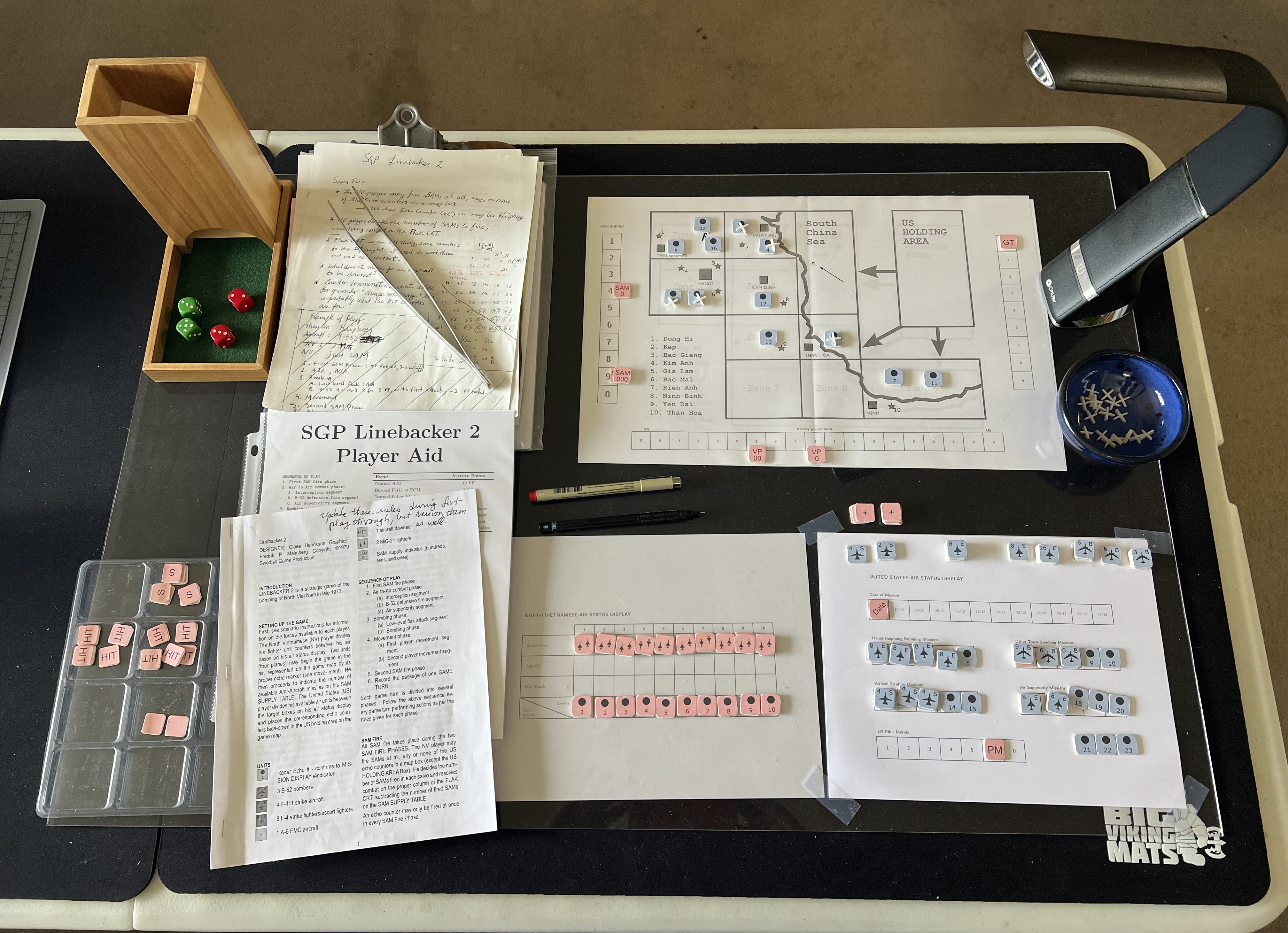
The turn sequence implies that every EC is handled at each step. Since I put 12 ECs on the map, SAM first fire is conducted for all 12. I need to get some SAM markers. I’ll use tile spacers. To make it simple, I’m going to emplace the US forces into the target box directly from the Air Status Display. I’ll worry about movement later.
- Bomb Hanoi with 12 B-52 escorted by 8 F4. But how does SAM work on a mixed mission? I am making the assumption that I can fly F4s on a B-52 mission, they are escorts, right? I need to review the literature. I read a whole book on Linebacker, of which I apparently retained very little. 6 SAMs, roll ‘em: 5-1, whiff.
- Bomb Haiphong, 12 B-52, 8 F4. 6 SAMs (988), roll 5-3 whiff.
- Bomb Hanoi, 12 B-52, 8 F4, 6 SAMs (982), roll 4-2 whiff.
- Bomb Haiphong 12 B-52, 8 F4, 6 SAMs (976), roll 5-6, Score! B-52 gets 1 hit for 10 VP to NV.
- Thanh Hoa with 12 B-52, roll 6-6 which is 2 hits on B-52, 20 VPs to NV.
- Vinh, 12 B-52, SAM roll 4-5, whiff as there is no escort.
- Thai Nguyen, 12 B-52 SAM roll 2-3 whiff.
- Than Hoa airfield, 10 F-111.
- Dong Hi 6 F-111.
- Yen Dai, 6 F-111.
- Kep, Air Superiority 24 F-4.
- Ninh Binh, Air Superiority 24 F-4.
Here’s a shot with updated “large” components.
What’s to like about the game
The game has several redeeming qualities. Linebacker 2 was operationally brutal requiring a large number of personnel ensuring a large amount of ordnance was delivered at the right time in the right place. The pace was intense, and that is reflected in the as the nine turns for each date. As with any respectable simulation of the US involvent in Vietnam, both sides can declare a victory of sorts by simply going the distance.
Combat operations are simple to understand and perform, and if not statistically valid, it would not be terribly difficult to adjust the odds. B-52 tailgunners did ruin the day for at least two MIG-21s, and the game allows for that possibility with B-52 defensive fire. I like that!
B-52 counters are demoninated in factors of three, which is historically accurate: 3 BUFFS to a “cell.” For example, Ivory cell with Ivory 01, Ivory 02, and Ivory 03. Cells were often grouped in “waves” of more or less three cells, which is ostensibly the 9 counter.
Likewise, MIGs typically operated in pairs.
The game has a small footprint, with even the “large” scale version easily fitting onto a small folding table. This includes map and fnaction placards, with room for dice tower or tray, counters, rules and beers if one is so inclined (I am not).
Where the game falls flat
Ok, so I only played part of Turn 1 on the first day of the campaign, but it was really clear I was going to be in for a brutal ride. It just didn’t feel like it was going to be any fun at all, at least not playing solitaire. Sadly, neither of my usual opponents joined me for a game. I probably should have asked them. Anyways, it felt like it was going to be a grueling experience so I ejected.
Combat incentives
One of my usual opponents pointed out that combat is not properly incentivized:
…the FLAK CRT only allows the NV to shoot down one play [sic] (rarely two), so aircraft after the first are invulnerable. So you might as well send lots of them! Fighters are handled similarly, additional fighters get you a higher probability of a kill, but only at the very high end do you take out more than one aircraft. It seems like you want to bunch up your fighters because only groups of six have any hope of hitting a B-52 and you don’t know what you’re going up against.
He has a point, but then again, USAF says no MIG-21s actually did down a B-52 and North Vietnam claims that two did. For the number of aircraft involved, there isn’t much difference between 0 and 2, so perhaps it did take six or more MIGs to have any hope of hitting.
Counters
Specifically, Hit counters. There aren’t enough Hit counters to make change appropriately to account for downed aircraft. And the Hit counters are all NV pink. Where are the Hit counters for USAF?
The aircraft counters are inconsistent, with a single aircraft and a numeral on the USAF counters, and two aircraft on the MIG counters. It’s not clear and not stated whether the number on the counter represents the number of aircraft, nor whether the MIG counters represent two aircraft. As it turns out, the intent can be inferred from history, provided one is already knowledgable.
The rules
If I were to succinctly describe the rules, the best I could do is state that there really aren’t any rules, just suggestions. This is likely obvious from the preceding discussion. What’s worse is that the game isn’t really fixable without eliminating the existing ambiguity, then filling in the remaining gaps. In other words, there aren’t enough rules to determine exactly how to play the game, much less whether the game is worth playing.
Would I play it again?
I think so; it feels like there is a game here. Whether it’s the same game the designer envisioned I could not say. I’d put it back on the table under either of the following conditions, after sufficient and currently undisclosed time has passed (not 2026 in other words):
-
Someone else really, really wants to play this thing, and is willing to put in the work necessary for at least incremental improvement. What this means is you have to wait for me to write down decisions and observations, that’s all. It would be less of “game play” and more of a “game development” situation.
-
I retire and find myself bored and decide to turn this into an actual solitaire game, which as I am thinking about it, might be pretty decent played as the US with the NV side under procedural control. I would dig very deep into the references to ensure as much actual history was incorporated into the game.
A third condition (a complete non-starter) might be someone decides they need to pay me a lot of money to make the game playable. I’m not holding my breath.
Upshot
This is the second vintage rebuild I’ve done, and probably not the last. Rebuilding is getting easier with both personal experience and improved technical tools, not the least of which is LLM technology. OCR work is now more or less trivial in comparison to OCR work in years past. Graphics work is still fundamentally challenging, LLMs aren’t that good at it, they aren’t trained for graphic reconstruction.
The mechanical parts such as laying out a counter sheet are much easier. Instead of writing the tools myself, I have an LLM write the tools. Overall, it’s fun and interesting, and one of these days perhaps I’ll resurrect an overlooked masterpiece. Probably not, but it doesn’t matter. This is about the journey not the destination.
Placeholder
- First SAM fire phase
- Air-to-Air combat phase:
- A. Interception segment
- B. B-52 defensive fire segment
- C. Air superiority segment
- Bombing phase:
- A. Low-level flak attack segment
- B. Bombing phase
- Movement phase:
- A. First player movement segment
- B. Second player movement segment
- Second SAM fire phase
- Record the passage of one GAME TURN